Mismatched data is an expensive operational bottleneck. Whether it is an e-commerce platform matching internal ledgers against payment gateways, a supply chain hub cross-referencing warehouse counts against vendor manifests, or an insurance provider auditing monthly claims, manual checking is slow and prone to errors.
When data systems don’t line up, it leads to profit leaks, compliance penalties, and hundreds of wasted manual labor hours.
To protect profit margins and scale operations, modern companies deploy Automated, Rule-Driven Data Reconciliation Systems. These platforms run continuously in the background, instantly catching discrepancies across separate data formats before they impact your bottom line.
Why Growing Businesses Need Automated Auditing
Relying on legacy spreadsheet templates or manual verification places an artificial ceiling on your operational scale. Transitioning to an automated, bi-directional data reconciliation engine delivers immediate advantages across your organization:
1. Plugging Profit Leakage Automatically
Even tiny discrepancies—such as a $0.05 variation on an invoice processing line—can snowball into significant capital losses when scaled across thousands of transactions. Automated variance rules track down discrepancies using both flat currency thresholds and relative percentage limits, immediately alerting your accounting team to overcharges or under-collections.
2. Up to 90% Reduction in Audit Labor Overhead
Instead of forcing highly skilled accounting and operations teams to manually comb through raw files to spot errors, automation isolates problems automatically. Your team receives a neat, pre-filtered exception log, letting them focus entirely on fixing errors rather than finding them.
3. Comprehensive Bi-Directional Risk Management
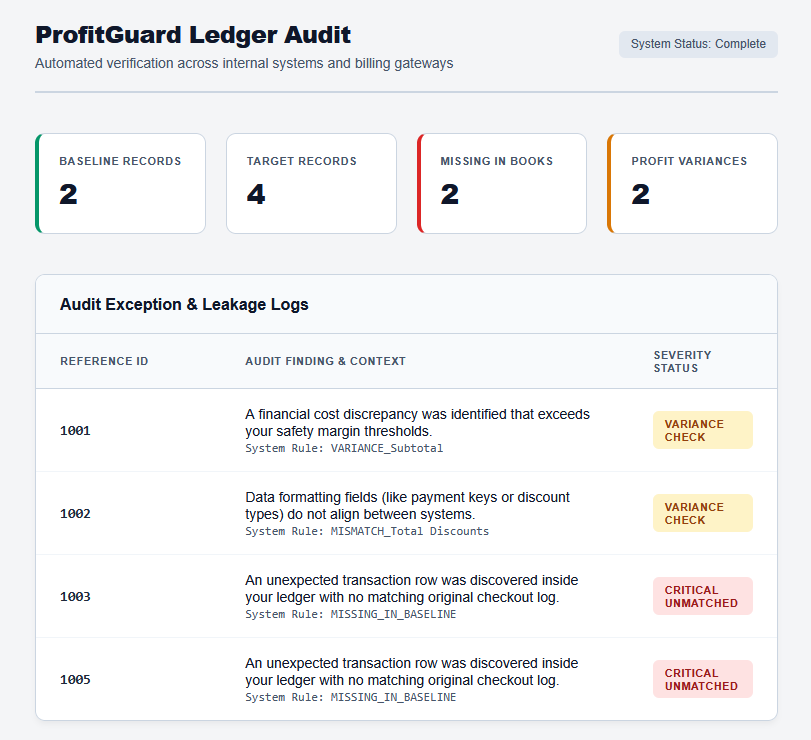
Most basic IT solutions only check if File A matches File B, completely missing the reverse scenario. A robust data engine runs a bi-directional verification loop. It spots entries that exist in your system but are missing from the vendor, and catches unexpected charges or records sent by third parties that don’t exist in your internal logs.
4. Seamless Integration Across Disparate Vendor Formats
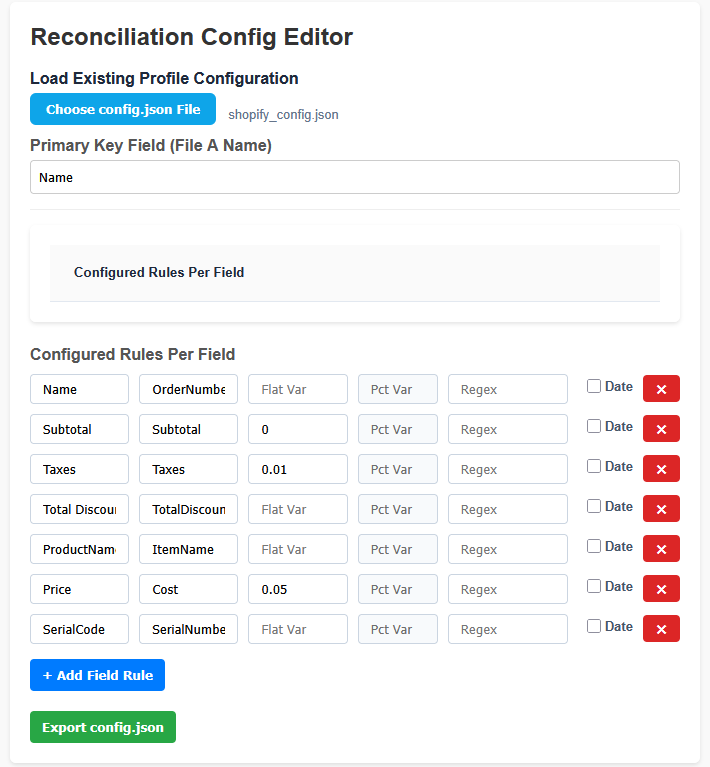
Third-party platforms rarely conform to your internal data layouts. They use different column headers, alternative currency labels, and varying date layouts. Our engine features a Dynamic Schema Translation Matrix that maps disparate third-party naming models directly to your internal database rules on the fly, entirely eliminating the need for manual file pre-formatting.
Business-Class Rule Hierarchy
A production-ready data auditing engine must handle more than simple exact text matches. Our business platform implements a robust, multi-layer validation pipeline tailored to your exact business logic:
| Rule Dimension | Operational Mechanism | Real-World SMB Example | Business Objective |
|---|---|---|---|
| Schema Translation | Dynamic column mapping between mismatched file structures. | Mapping raw Stripe or Shopify payout rows to standard bookkeeping headers. | Integrates disparate third-party file structures without manual pre-processing. |
| Relative Variances | Tracks financial discrepancies using flat values or relative percentages. | Isolating and tolerating predictable credit card transaction fees on incoming sales. | Flags suspicious transaction drift while tolerating predictable credit card fees. |
| Date Normalization | Unifies alternative date formats (e.g., YYYY-MM-DD, DD/MM/YYYY) automatically. |
Syncing international vendor dates with your internal QuickBooks timeline. | Eliminates false flags caused by cross-border system formatting differences. |
| Text Standardization | Trims whitespace, strips carriage returns, and normalizes hyphens. | Matching messy checkout names to structured CRM accounts in HubSpot. | Prevents trailing spaces or mixed text casing from corrupting lookup pipelines. |
| Format Enforcement | Validates data patterns using strict regex string enforcement. | Verifying that raw incoming vendor SKUs exactly match internal catalog IDs. | Guarantees compliance by verifying that incoming Serial Codes or IDs match internal company models. |
Supported Small Business Ecosystem Integrations
Our automated engine provides out-of-the-box translation matrix mappings for the tools your small business uses every day, entirely bypassing the need for manual spreadsheet adjustments:
E-Commerce & Payment Gateways
- Shopify: Automatically untangles gross product sales, discounts, shipping fees, and regional sales tax liabilities from standard store exports.
- Stripe: Instantly processes dense Balance Summary sheets, parsing out processing fees and gross income to isolate net revenue.
Accounting & Core Ledgers
- QuickBooks Online: Generates clean, pre-mapped transaction inputs that feed straight into your bank feeds without manual columns adjustment errors.
- Xero: Formats multi-column statement rows into clean, balanced ledger items for immediate automated bank reconciliation.
CRM & Operational Tools
- HubSpot: Bridges the gap between sales pipelines and financial realities by cross-checking “Closed-Won” data payloads with true accounting records.
Configure Your Custom Audit Rules
Bypass manual text configurations. Use our interactive management utility to model your operational rules, align mismatched third-party column headers, set your financial variance thresholds, and generate your custom integration template instantly.
Frequently Asked Questions
What exactly is data reconciliation, and why does our business need it?
Data reconciliation is an automated operational control that verifies that transactional records stored in two independent internal or external systems are identical. Businesses utilize automated reconciliation to protect against billing errors, vendor overcharges, inventory inaccuracies, and compliance audit failures.
Can this system handle files with completely different columns or schemas?
Yes. The solution implements a flexible column mapping layer that bridges formatting gaps automatically. Your operations team simply inputs the vendor’s alternative header names into the schema matrix, and the platform translates and checks the records without changing your internal data format.
How does the platform handle international dates or currency fluctuations?
The engine features dedicated date standardizers that automatically normalize variations (such as MM-DD-YYYY, DD/MM/YYYY, and YYYY.MM.DD) into a single format before validating them. For financial fluctuations, you can set acceptable flat tolerances or percentage ranges to accommodate predictable credit card fees or conversions while still flagging major discrepancies.
Is our data secure during processing?
Yes. Unlike clunky web-based software or third-party cloud tools that require uploading sensitive financial documents to an external server, our high-performance architecture runs natively inside your company’s existing IT setup. Your private financial data never leaves your secure environment.
Stop Overlooking Financial Leakage. Secure Your Operations.
Managing complex data manually introduces unacceptable risk to your business operations. Our solutions engineering team builds and integrates high-performance data automation systems designed to process multi-gigabyte files seamlessly, instantly connecting your disparate internal tools with cloud data platforms.
Don’t let unverified vendor invoices or data mismatches drain your revenue.
Contact our Automation Solutions Team today to schedule a personalized architectural review, arrange an operations audit, or discuss custom automation systems built for your company’s workflows.