How Does Agile Software Development Work?
Agile software development works by breaking large, complex engineering projects into small, iterative cycles called sprints, allowing cross-functional teams to continuously deliver working software and adapt instantly to changing requirements. Instead of following a rigid, linear timeline, Agile centers on collaborative planning, frequent value delivery, and ongoing adaptation.
The 4 Pillars of the Agile Manifesto
Established by seventeen visionary software developers in 2001, the foundations of Agile shift the focus away from bureaucratic administration and place it squarely on product delivery:
- Individuals and interactions over processes and tools
- Working software over comprehensive documentation
- Customer collaboration over contract negotiation
- Responding to change over following a plan
Inside the Agile Workflow: How a Sprint Executes
Rather than building an entire application behind closed doors and launching it months later, Agile teams utilize a repeatable operational framework to ship code incrementally.
1. The Iteration Cycle (Sprints)
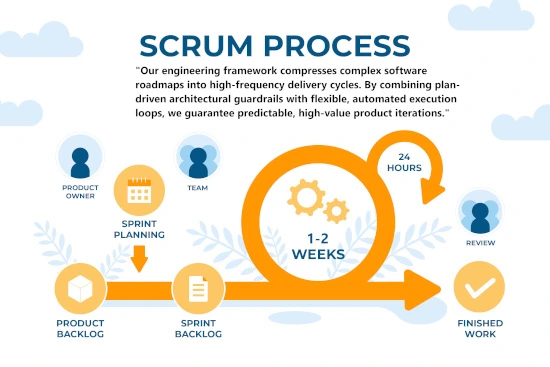
Agile methods compress product development into strict timeboxes called sprints, which typically last between one and four weeks. During a single sprint, a dedicated engineering team executes the entire software development lifecycle:
- Sprint Planning: Defining the highest-priority features pulled from the product backlog.
- Continuous Engineering: Writing clean, scalable code aligned with architecture standards.
- Embedded Testing: Running automated unit testing and acceptance testing in parallel with active development.
- Stakeholder Review: Demonstrating a functional, testable software increment to the client.
2. High-Bandwidth Collaboration
Agile explicitly eliminates communication silos. By focusing on rapid alignment loops, engineers eliminate the delayed turnaround times caused by endless email chains or massive specification documents.
Every high-performing team includes a dedicated customer representative—such as a Product Owner—who remains accessible to clarify business requirements, prioritize tasks, and optimize the overall return on investment (ROI).
3. Continuous Integration and Quality Focus
- Daily Stand-ups: Teams sync for 15 minutes every morning to align on the day’s goals and immediately flag technical roadblocks.
- Built-in Quality Assurance: Teams utilize advanced engineering methodologies like Continuous Integration/Continuous Deployment (CI/CD), test-driven development (TDD), Behavior-Driven Development (BDD), and regular code refactoring. This guarantees that the software remains production-ready at the end of every sprint.
When to Choose Agile vs. Waterfall
Choosing the right development framework directly impacts your project’s budget, timeline, and quality. If you are analyzing how to structurally set up your next project, explore our guide on how to choose a software development methodology to weigh your options.
| Project Metric | Agile Approach (Adaptive) | Waterfall Model (Predictive) |
|---|---|---|
| Requirements | Fluid and emergent; shaped by continuous user feedback. | Fixed and locked down completely before writing any code. |
| Testing Frequency | Executed daily within the same sprint as active development. | Isolated to a distinct, high-risk phase at the end of the timeline. |
| Delivery Model | Incremental deployments; regular shipping of working features. | Single major deployment at the very end of the contract. |
| Risk Management | Low; assumptions are tested and adjusted every two weeks. | High; architectural errors may go unnoticed until deployment. |
The Truth About Documentation in Agile
A frequent critique of Agile methodologies is the misconception that developers skip documentation entirely. In practice, mature engineering teams practice “Just Barely Good Enough” (JBGE) documentation. The objective is to produce lean, highly accurate architectural maps, API schemas, and onboarding notes that genuinely help engineers maintain the project, rather than creating hundreds of pages of static paperwork that immediately fall out of sync with the live codebase.
Overcoming Agile Hurdles at Scale
While highly effective for modern startups, pure Agile frameworks can experience friction when deployed across legacy corporate structures with fixed annual budgets. To bridge this gap, many enterprise projects deploy a Hybrid Delivery Model. This approach blends rigorous, plan-driven architectural guardrails with nimble, execution-focused Agile sprints, allowing businesses to maintain strict compliance without sacrificing development speed.
To better understand how these iterative engineering shifting models protect operational resources, read the 9 proven benefits of Agile software development every business should know.
Streamline Your Product Engineering Timeline
Building high-performance, scalable platforms demands a technical partner who masters both elite engineering and modern, transparent Agile workflows. We eliminate the guesswork from product development by delivering predictable, high-value software increments tailored directly to your business metrics.
Ready to accelerate your product roadmap?
We eliminate execution guesswork, reduce architectural errors, and bring predictable velocity to your enterprise software delivery. Partner with an elite Agile team tailored exactly to your business metrics.