Custom MySQL Database Design Services
Build Secure, Scalable, and High-Performance Data Architecture for FinTech & E-Commerce
Scaling an online storefront or financial platform requires more than just storing data—it requires a flawless data architecture. We specialize in custom MySQL database design services that prevent checkout bottlenecks, ensure ironclad transactional integrity, and scale effortlessly alongside your business.
Why MySQL for FinTech & E-Commerce Architecture?
When dealing with online transactions, financial ledgers, and massive inventories, your database technology matters. We leverage MySQL to deliver enterprise-grade performance tailored to your specific domain:
- ACID Compliance: Essential for FinTech to ensure financial transactions are processed reliably, securely, and without data corruption.
- High Availability & Scalability: Structured to handle sudden e-commerce traffic spikes (like Black Friday) without dropping connections or lagging checkout pages.
- Optimal Indexing: Expertly configured indexing to reduce query latency, ensuring real-time inventory updates and fast financial reporting.
Our Core Database Engineering Capabilities
We bridge the gap between complex technical engineering and your specific business requirements. Our architectural design process spans three critical layers to ensure maximum efficiency:
1. Conceptual & Logical Data Modeling
We map out your business rules into a highly structured data model. For E-Commerce, this means structuring parent-child relationships for complex product catalogs, variations, and customer orders. For FinTech, we build precise relational structures that map account balances, ledger entries, and payment gateways with zero redundancy.
2. High-Performance Physical Design
The physical design dictates exactly how your data sits on storage media. We fine-tune your MySQL configuration by defining precise data types, writing optimized stored procedures, and creating indexing options within the DBMS data dictionary to maximize hardware capabilities.
3. Security & Compliance Architecture
Financial and consumer data require strict protection. We build schemas with built-in audit trails, secure data encryption structures, and optimized structures for seamless, rapid backups.
Comparison: Relational vs. Non-Relational for Transactions
This table clearly highlights why a relational MySQL setup fits transaction-heavy applications best:
| Database Feature | Relational MySQL (Our Choice) | Non-Relational (NoSQL) | FinTech / E-Commerce Impact |
|---|---|---|---|
| Data Structure | Strict tables, rows, and foreign key columns | Loose, unstructured document collections | Ensures absolute consistency across orders and accounts. |
| Transaction Safety | Full ACID Compliance (Atomicity, Consistency, Isolation, Durability) | Eventual consistency (varies by system) | Prevents critical errors like double-spending or inaccurate ledger balances. |
| Query Relationships | Highly optimized complex JOIN operations | Embedded documents or manual application links | Allows real-time reporting on complex financial and inventory data. |
Enterprise Blueprint: Real-World Database Implementation
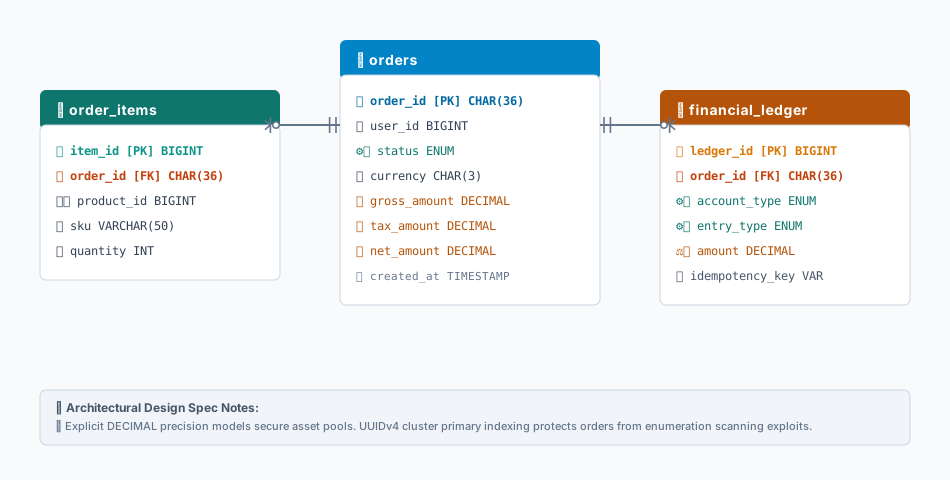
-- ============================================================================
-- ENGINE: MySQL 8.x (InnoDb)
-- ARCHITECTURE: High-Concurrency Ledger & Order Management
-- FEATURES: ACID Compliant, Exact Decimal Precision, Optimized Multi-Column Indexes
-- ============================================================================

SET FOREIGN_KEY_CHECKS = 0;
DROP TABLE IF EXISTS `financial_ledger`;
DROP TABLE IF EXISTS `order_items`;
DROP TABLE IF EXISTS `orders`;
SET FOREIGN_KEY_CHECKS = 1;

-- ----------------------------------------------------------------------------
-- 1. ORDERS TABLE
-- Holds core transaction metadata. Handled via InnoDB row-level locking.
-- ----------------------------------------------------------------------------
CREATE TABLE `orders` (
  `order_id` CHAR(36) NOT NULL, -- UUIDv4 to eliminate sequential ID scanning exploits
  `user_id` BIGINT UNSIGNED NOT NULL,
  `status` ENUM('pending', 'processing', 'completed', 'failed', 'refunded') NOT NULL DEFAULT 'pending',
  `currency` CHAR(3) NOT NULL DEFAULT 'USD',
  `gross_amount` DECIMAL(15, 4) NOT NULL, -- 4 decimal places for precise international fraction processing
  `tax_amount` DECIMAL(15, 4) NOT NULL DEFAULT 0.0000,
  `net_amount` DECIMAL(15, 4) NOT NULL,
  `created_at` TIMESTAMP(3) NOT NULL DEFAULT CURRENT_TIMESTAMP(3),
  `updated_at` TIMESTAMP(3) NOT NULL DEFAULT CURRENT_TIMESTAMP(3) ON UPDATE CURRENT_TIMESTAMP(3),
  PRIMARY KEY (`order_id`),
  KEY `idx_user_created` (`user_id`, `created_at` DESC), -- Speeds up 'My Orders' user account pipelines
  KEY `idx_status_created` (`status`, `created_at`) -- Drives real-time internal fulfillment dashboards
) ENGINE=InnoDB DEFAULT CHARSET=utf8mb4 COLLATE=utf8mb4_unicode_ci;

-- ----------------------------------------------------------------------------
-- 2. ORDER ITEMS TABLE
-- Normalizes inventory transactions to prevent data mutations.
-- ----------------------------------------------------------------------------
CREATE TABLE `order_items` (
  `item_id` BIGINT UNSIGNED NOT NULL AUTO_INCREMENT,
  `order_id` CHAR(36) NOT NULL,
  `product_id` BIGINT UNSIGNED NOT NULL,
  `sku` VARCHAR(50) NOT NULL,
  `quantity` INT UNSIGNED NOT NULL,
  `price_per_unit` DECIMAL(15, 4) NOT NULL,
  PRIMARY KEY (`item_id`),
  CONSTRAINT `fk_items_order_id` FOREIGN KEY (`order_id`) REFERENCES `orders` (`order_id`) ON DELETE CASCADE
) ENGINE=InnoDB DEFAULT CHARSET=utf8mb4 COLLATE=utf8mb4_unicode_ci;

-- ----------------------------------------------------------------------------
-- 3. FINANCIAL LEDGER TABLE
-- Double-entry immutable accounting schema. Rows are INSERT-ONLY to comply with
-- strict FinTech auditing regulations.
-- ----------------------------------------------------------------------------
CREATE TABLE `financial_ledger` (
  `ledger_id` BIGINT UNSIGNED NOT NULL AUTO_INCREMENT,
  `order_id` CHAR(36) NOT NULL,
  `account_type` ENUM('revenue', 'tax_payable', 'payment_processing_fee', 'accounts_receivable') NOT NULL,
  `entry_type` ENUM('debit', 'credit') NOT NULL,
  `amount` DECIMAL(15, 4) NOT NULL,
  `idempotency_key` VARCHAR(255) NOT NULL, -- Safeguards against duplicate payment gateway webhook executions
  `recorded_at` TIMESTAMP(3) NOT NULL DEFAULT CURRENT_TIMESTAMP(3),
  PRIMARY KEY (`ledger_id`),
  UNIQUE KEY `uk_idempotency` (`idempotency_key`), -- Database layer blockade against double charges
  CONSTRAINT `fk_ledger_order_id` FOREIGN KEY (`order_id`) REFERENCES `orders` (`order_id`) ON DELETE RESTRICT
) ENGINE=InnoDB DEFAULT CHARSET=utf8mb4 COLLATE=utf8mb4_unicode_ci;
Our Step-by-Step Database Design Process
Our structured workflow guarantees that your database is built perfectly for your specific applications, minimizing development friction and launch delays.
Discovery & Requirements –> Conceptual Schema –> Physical Optimization –> Deployment & Testing Eliciting domain metrics Mapping relationships Data types & Indexing SQL schema generation
- Step 1: Domain Discovery & Requirements Analysis
Database design requires explicit domain knowledge. Our architects work closely with your financial or retail experts to map out your specific system rules and define every discrete data element your application needs to track. - Step 2: Conceptual Schema Creation
We isolate and map data dependencies. By identifying how data points relate to one another (e.g., matching a single user profile to multiple secure checkout sessions), we superimpose a clear relational structure upon your information. - Step 3: Physical Database Design
We translate the logical layout into physical storage parameters. This includes choosing optimal data types (e.g., exact fixed-point types for currency calculations), planning indexing paths, and engineering the server hardware/software specifications. - Step 4: SQL Code Generation
Finally, we output a fully attributed data model written in clean Data Definition Language (DDL). This SQL code is deployed directly to generate your production-ready database tables, views, and structural constraints.
Frequently Asked Questions (FAQ)
What is the most important factor in database design for FinTech applications?
The most critical factor in FinTech database design is ensuring transactional integrity through ACID compliance. This guarantees that all financial transactions are processed completely or not at all, preventing mismatched account balances or missing ledger data during unexpected system interruptions.
How does proper MySQL database design speed up an E-Commerce website?
Proper database design speeds up e-commerce sites by implementing precise indexing and reducing data redundancy. This ensures that resource-heavy queries—like searching through thousands of product variants or loading a customer’s order history—execute in milliseconds, preventing slow page load speeds and reducing checkout abandonment.
Why choose MySQL over a NoSQL database for financial records?
MySQL is preferred for financial records because it uses a relational model based on mathematical relations and strict foreign key constraints. This structure enforces rigid rules on how data links together, making it inherently more secure and accurate for balancing ledgers compared to the loose, eventual-consistency model of NoSQL databases.
Ready to Architect a Scalable, High-Performance Database?
Stop letting slow queries, data redundancy, and scaling limitations hold back your software. Fill out the form to request a custom schema consultation and detailed project quote.