Helping WroughtWorks Move Beyond Legacy Ecommerce Technology
How we modernized an ecommerce platform we originally designed and built more than a decade ago, preserving a proven foundation while creating a faster, more flexible shopping experience for the future.
A Better Ecommerce Experience Starts With Better Technology
Running a successful ecommerce business requires more than great products. Your website needs to provide a smooth shopping experience, make products easy to discover, and give your business the flexibility to evolve as customer expectations and business requirements change.
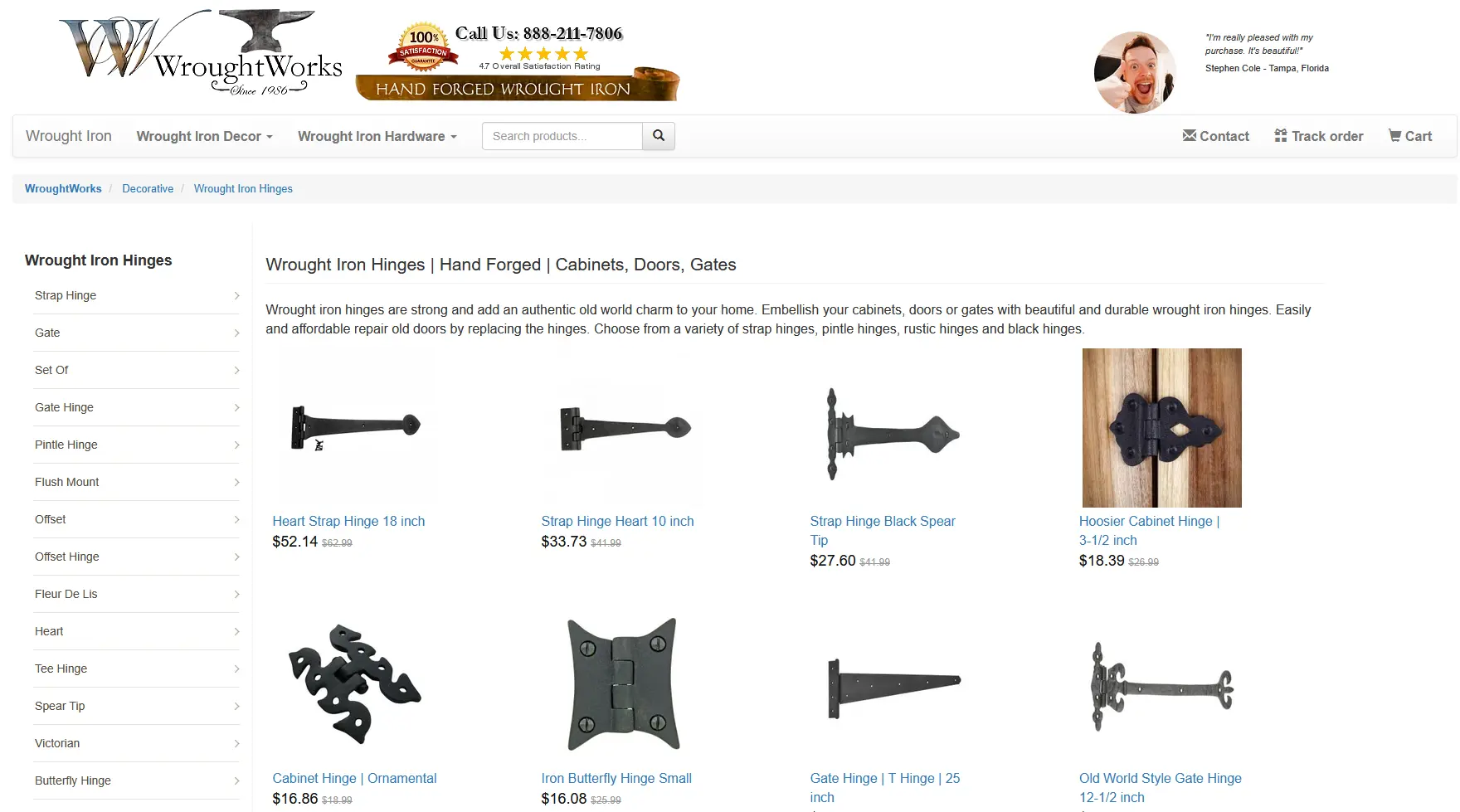
More than a decade ago, we designed and developed a custom ecommerce website and application for WroughtWorks, a specialty ecommerce business offering handcrafted decorative wrought iron products and traditional hardware. The platform served the business exceptionally well, providing a reliable foundation for its ecommerce operations for many years.
But even successful software eventually needs to evolve.
As technology advances and business requirements change, older applications can become increasingly difficult to maintain, extend, and adapt. Over time, the underlying technology can limit opportunities for improvement, making it harder to introduce new capabilities and respond to changing business needs.
That was the opportunity behind our modernization of WroughtWorks.
Having originally built the platform, we understood its history, architecture, and the business it supported. We undertook a comprehensive modernization of its custom-built PHP ecommerce website and application, replacing the legacy platform with a completely rewritten solution built using Go.
The objective wasn’t simply to replace aging technology. It was to build on the success of a platform that had served WroughtWorks for more than a decade while creating a faster, more maintainable, and more flexible foundation for the next chapter of its ecommerce business.
This was much more than a programming language conversion. We rethought the entire application, from the database and backend architecture to the customer-facing shopping experience.
We also made an important decision from the beginning: preserving the existing functionality and URLs was our first priority.
The goal was to modernize the technology without disrupting the established business, its existing website structure, or the functionality customers already relied on.
The result is a noticeably faster application with improved functionality, better product discovery, and a more maintainable foundation for future development.
The objective wasn’t simply to replace old technology. It was to preserve what already worked, make it better, and create a platform ready for what’s next.
Explore the live website: wroughtworks.com
The Challenge: When Legacy Technology Starts Holding Your Business Back
Custom-built ecommerce applications can be an excellent choice for businesses with specialized products, unique requirements, and workflows that don’t fit neatly into off-the-shelf ecommerce platforms.
However, as these applications evolve, maintaining the original architecture can become increasingly challenging.
Over time, new features are introduced, integrations accumulate, business requirements change, and the original application becomes more complicated.
The technology that once supported business growth can eventually become an obstacle to it.
Our project began with a custom-built PHP ecommerce platform that needed a more modern foundation.
The challenges extended beyond application performance. We wanted to address the underlying complexity that made ongoing development and improvements increasingly difficult.
The modernization focused on several important business and technical objectives:
- Improve performance: Make the website and application more responsive for customers.
- Improve maintainability: Replace aging application code with a cleaner, more manageable architecture.
- Support business growth: Create a foundation capable of accommodating evolving requirements and a growing product catalog.
- Reduce technical debt: Address accumulated complexity and limitations in the original application.
- Enhance the customer experience: Improve product discovery, browsing, and overall website functionality.
- Improve security: Introduce better application and database query practices.
- Accelerate development: Make it easier to implement new features and respond to changing business needs.
Rather than continuing to patch and extend the existing PHP application, we determined that a comprehensive modernization would provide a better long-term solution.
We wanted to rebuild the application in a way that addressed the limitations of the original platform while preserving the business functionality that customers and the business depended on.
First Priority: Preserve What Works While Building for the Future
A complete ecommerce application rewrite doesn’t mean starting the business over.
One of our first priorities was to preserve the existing functionality and URLs while improving the underlying application architecture.
For an established ecommerce business, its website represents much more than a collection of pages and products.
Existing product URLs, category structures, search engine visibility, inbound links, customer workflows, and integrations can all contribute to the ongoing success of the business.
Changing these unnecessarily can introduce disruption, create additional work, and potentially affect valuable search engine visibility.
We approached the modernization with this in mind.
Rather than simply rebuilding the application and changing everything along the way, we prioritized maintaining the existing customer-facing functionality and URL structure while improving how the application delivered that functionality.
This meant taking care to preserve established website URLs rather than treating the project as an opportunity to reorganize everything.
It also provided an opportunity to improve existing features rather than simply reproduce them.
The result is a modernized application that retains the familiar foundation of the original ecommerce business while providing a much better technology platform underneath.
The goal was to make the platform better without making the business start over.
And importantly, preserving the existing functionality was just the beginning.
With the underlying application now modernized, we have a much stronger foundation for introducing additional improvements, new features, and better customer experiences over time.
The Modernization: Rebuilding the Entire Ecommerce Platform
We chose Go as the foundation for the new application.
Go offers an excellent combination of performance, efficient concurrency, straightforward deployment, and maintainable code. It is particularly well suited to building efficient backend applications and APIs.
Instead of simply translating existing PHP functionality into Go, we took the opportunity to rethink how the entire application worked.
The modernization included:
- Complete redevelopment of the ecommerce application using Go.
- Modernization of the website frontend.
- Redevelopment of backend functionality and APIs.
- Migration from MySQL to SQLite.
- Database query optimization.
- Improvements to product discovery and browsing.
- Modernization of third-party integrations.
- Infrastructure and deployment improvements.
By addressing these areas together, we could improve the complete ecommerce experience rather than simply replacing the underlying programming language.
The objective was to create an application that would be easier to operate, maintain, and extend while providing a better experience for customers.
A Faster Foundation: Go and Memory-Mapped SQLite
One of the most interesting aspects of this project was the database architecture.
We moved away from the original MySQL implementation and migrated the application to SQLite, using a fully memory-mapped database configuration.
Rather than treating SQLite as simply a lightweight database replacement, we designed the data access strategy around the application’s actual requirements.
Memory-Mapping the Entire Database
The entire SQLite database is memory-mapped, with the configured memory-map size exceeding the actual database file size.
This allows the operating system to manage database file access through virtual memory, providing an efficient approach to accessing frequently used information.
For the product database, we also implemented a read-only access strategy using SQLite connection options including:
mode=rofor read-only access.immutable=1for databases that are not modified while in use._query_only=onto restrict connections to read operations._mmap_sizeconfigured to accommodate the entire database.- An explicitly configured SQLite page cache.
This approach is particularly useful for read-heavy ecommerce workloads where product information, categories, attributes, and other catalog data are accessed frequently.
Optimizing Database Queries
The migration also provided an opportunity to review and improve database queries throughout the application.
We focused on:
- Improving query efficiency and data retrieval.
- Reducing unnecessary database operations.
- Improving query safety.
- Streamlining database access patterns.
- Supporting more flexible product catalog functionality.
These improvements contributed to the noticeably faster response times of the modernized application.
The important distinction is that we didn’t simply move the data from one database to another. We redesigned how the application accesses and works with it.
Making Product Discovery Easier
A good ecommerce experience isn’t just about loading pages quickly. Customers also need to find what they’re looking for without unnecessary effort.
This was an important consideration for WroughtWorks, which offers a diverse catalog of decorative hardware and specialty products.
Dynamic Product Filtering
We introduced dynamic product filtering based on product tags.
This provides a more flexible way to organize and filter products without relying exclusively on rigid, predefined filtering options.
Product tags provide a flexible foundation for creating relevant filtering options and helping customers narrow down product selections.
The benefits include:
- More flexible product filtering.
- Easier navigation through product catalogs.
- Improved product discovery.
- Greater flexibility as product attributes and catalog requirements evolve.
- Easier implementation of additional filtering capabilities.
This also makes it easier for the business to evolve its product organization without continually expanding a collection of hardcoded filtering rules.
For ecommerce businesses with diverse or growing catalogs, these improvements can make a meaningful difference to the customer experience.
Improving the Product Browsing Experience
We also identified opportunities to improve two important customer-facing features: product image zoom and loading additional products.
Better Product Image Zoom
The original image zoom functionality repeatedly requested the full-size product image through additional HTTP GET requests.
This created unnecessary network traffic and introduced avoidable delays when customers interacted with product images.
We improved the image zoom implementation to avoid repeatedly downloading the same full-size image.
This makes image interactions more efficient and provides a smoother experience when customers inspect product details.
More Efficient Product Loading
The original website used automatic load-on-scroll functionality to retrieve additional products as customers browsed through product listings.
We improved the product loading functionality to provide a more efficient and controlled browsing experience.
Combined with the improved filtering and image handling, these changes make browsing the product catalog more responsive and convenient.
These improvements might seem relatively small individually, but together they contribute to a more polished and enjoyable shopping experience.
Simplifying the Technology Behind the Business
Modernization also gave us an opportunity to simplify how the application is deployed and maintained.
The new ecommerce application runs as a single, self-contained Go service.
Combined with SQLite’s embedded database architecture, this creates a cohesive application stack without requiring multiple independently deployed services for the core application functionality.
This provides several practical advantages:
- Simpler application deployment.
- Fewer independently managed application components.
- Easier ongoing maintenance.
- A more straightforward development process.
- Greater flexibility for future enhancements.
We believe modern application architecture should be driven by business requirements rather than unnecessary infrastructure complexity.
For small and mid-sized businesses, this is particularly important. Modernizing technology doesn’t have to mean introducing more moving parts or creating additional operational overhead.
Sometimes a simpler, purpose-built architecture is exactly what a business needs.
The Results: A Faster, More Flexible Ecommerce Platform
The modernization delivered improvements across the entire application, from backend performance and database access to customer-facing functionality.
Noticeably Faster Application Response Times
The combination of Go, memory-mapped SQLite, and optimized database queries resulted in a very noticeable improvement in application responsiveness.
Customers benefit from a faster, more responsive shopping experience, while the business benefits from a more efficient application foundation.
Improved Customer Experience
Product discovery, image zoom, and product loading were all improved.
Customers can browse products more efficiently, use flexible filtering options, and interact with product images without unnecessary repeated downloads.
Preserved Existing Functionality and URLs
The modernization was designed to protect the established ecommerce experience.
By prioritizing existing functionality and URLs, we avoided treating the rewrite as a reason to disrupt the business’s existing website structure.
This is an important consideration for any established ecommerce business undertaking a major technology change.
Improved Application Functionality
The modernization provided an opportunity to improve existing features and introduce better ways of working with ecommerce data.
Rather than being limited by the original application’s design, the new platform provides a cleaner foundation for additional functionality.
Easier and Faster Feature Development
One of the most important long-term benefits is the ability to introduce new features more easily.
The modernized application is easier to understand, maintain, and extend.
This reduces the friction associated with working around legacy application limitations and allows development efforts to focus more directly on improvements that provide business value.
Better Maintainability and Security Practices
The complete rewrite also allowed us to address accumulated technical debt and improve application and database query practices.
The result is a more maintainable codebase with safer query handling and a modern architecture that is easier to evolve.
Simplified Application Operations
Deploying the application as a single, self-contained Go service, together with an embedded SQLite database, provides a simpler foundation for deployment and ongoing application management.
This Is Just the Beginning
The first priority of this project was to modernize the existing platform while preserving and improving the functionality that the business already depended on.
That was an important foundation to establish.
With the legacy application replaced, database access improved, and the customer-facing experience enhanced, we now have a much more flexible platform for future development.
Instead of continually working around the limitations of an aging application, new functionality can be developed on a modern foundation.
This creates opportunities to continue improving product discovery, customer experiences, business functionality, and the overall capabilities of the ecommerce platform.
The modernization wasn’t intended to be the final destination.
It was the first step toward making the ecommerce platform better over time.
What Other Ecommerce Businesses Can Learn From This Project
WroughtWorks is an example of a challenge faced by many small and mid-sized ecommerce businesses.
An established custom application may still perform its essential business functions, but that doesn’t necessarily mean it is the best foundation for future growth.
Over time, technical limitations can make improvements increasingly difficult.
New functionality takes longer to develop. Product discovery becomes harder to improve. Performance issues affect the shopping experience. Developers spend more time maintaining existing code and less time building new capabilities.
The answer isn’t always to abandon a custom ecommerce platform and move to an entirely different system.
In many cases, modernizing the existing application can provide a more practical path forward.
A carefully planned modernization can:
- Preserve existing functionality and established website URLs.
- Improve website performance.
- Enhance the customer shopping experience.
- Simplify application maintenance.
- Make new features easier to implement.
- Address accumulated technical debt.
- Establish a better foundation for future business requirements.
The right approach depends on the business, its existing application, and its long-term objectives.
The important thing is to ensure that the technology supports the business rather than limiting it.
For businesses that have invested years in developing a custom ecommerce application, modernization can provide a way to protect that investment while preparing for what’s next.
See the Modernized Ecommerce Platform in Action
The best way to appreciate the results of this project is to explore the actual website.
Visit WroughtWorks and experience the modernized ecommerce application firsthand.
Explore the product catalog, browse products, and see how the shopping experience comes together.
Is Your Ecommerce Platform Holding Your Business Back?
If your ecommerce website is running on an aging custom application, you’re not alone.
Many established small and mid-sized businesses face similar challenges with performance, technical debt, maintainability, and the cost of introducing new functionality.
You don’t necessarily need to abandon your existing ecommerce business model or move to an expensive, restrictive platform.
Sometimes the better solution is to modernize the technology you already have.
We help businesses transform legacy ecommerce applications into faster, more flexible, and maintainable platforms using modern application architecture and practical software engineering.
Whether you’re considering a complete application rewrite, improving website performance, or simply making your existing platform easier to develop and maintain, we can help evaluate the options.
Let’s talk about making your ecommerce technology work better for your business.